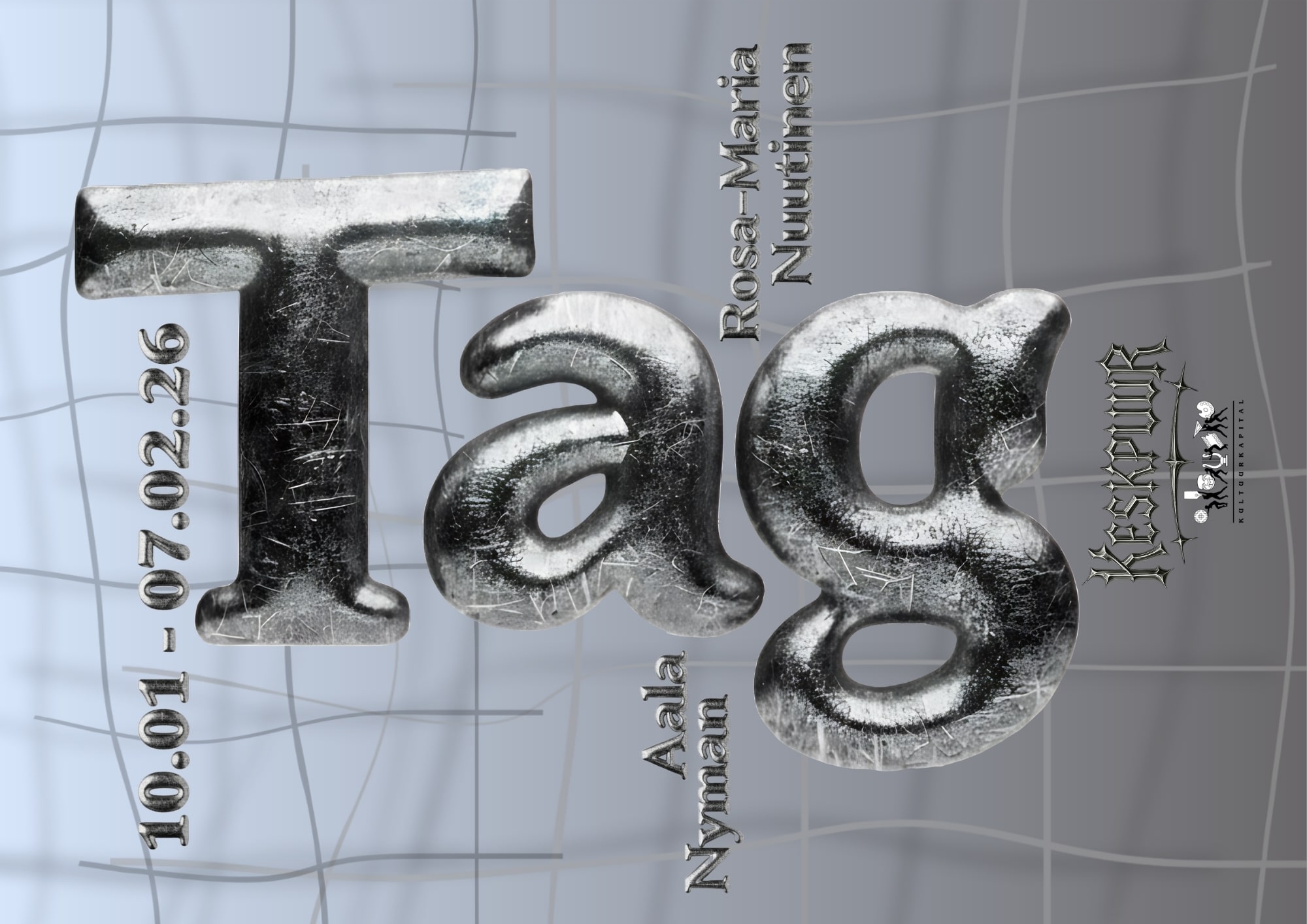
Tag
Aala Nyman and Rosa-Maria Nuutinen
10.01 - 08.02.2026
------------
Tag
Keskpuur is pleased to present Tag, a two person exhibition by Aala Nyman and Rosa-Maria Nuutinen, bringing together two practices that explore states of neglect, decay and memory through the life cycle of objects and buildings.
Cast aluminium knots and ceramic tubes recall the foam insulation pipes left behind at construction sites. forgotten woollen sweaters and pants wrap around the pipes. In Aala Nyman’s work, she uses everyday objects as a source for sculpture, her choice to cast found structural objects into aluminium and ceramic forms creates impressions that are both familiar and foreign. Through this process, the objects are experienced outside their original context which shapes our perception and memory. Nyman positions her work with the ready-made traditions of Beuys, Duchamp, and Elsa von Freytag-Loringhoven. God (1917), made by Freytag-Loringhoven and Morton Livingston Schamberg, is a ready-made sculpture of an upside-down rusted U-bend pipe attached to a mitre box, and it is often cited as a foundational work of the Dada movement. In Nyman’s approach she recasts found materials into a new material so that the ready-made becomes the prototype of the sculptures. Within Dada, clothing and bodily adornment operate as performative readymades. In Freytag-Loringhoven’s photographs , she was often seen posing in an assembled dress that included found materials such as a tin-can bra, a birdcage, curtain rings, and feathers and tassels, pushing the boundaries between art and life. Nyman treats materials as a combination of performative, sculptural and playful gestures. The sculptures maintain a close relationship to their original function, yet drawing attention to neglected or unseen qualities. While Nyman’s work is about material memories and tiny details we don’t notice daily, Rosa-Maria Nuutinen’s work explores how our memories and physicality react to the environment and surroundings. In the exhibition glass vessels are placed around the gallery wall and floor, mimicking the circuit breakers and electrical board in the gallery. The works suggest that the building itself is a relic of the past, what is left is some leaking veins and arteries (casted pipes and plastic tubes) and heart and organs (glass vessels) trying to pump blood to the building to keep traces of memory alive. In Susan Sontag’s “Illness as Metaphor and AIDS and Its Metaphors” she argues that the metaphor of the body as machine is dehumanizing and denying human qualities such as emotions and cognition. In Nuutinen’s work, the building is compared to the body, but not a functioning one, it is one that is decaying and it appears more like a body that has been left behind. Hug (2025), a drawing created by chemically etching imagery into steel plates using acid, depicts an image of human-like shapes fusing together, no longer human nor machine. Through this fusion and material process, the work explores the body and the machine metaphor as erosion and residue. The metaphor thus reveals an accumulation of memory that is marked by absence, fragility, and the life cycles of materials.
-KitKit Para, 2026
This exhibition is supported by Cultural Endowment of Estonia
Rosa-Maria Nuutinen is a Tallinn based Finnish multidisciplinary artist working with drawing, sculpture, creative writing and film. In her work Nuutinen explores the juxtaposition of the physical and the digital by questioning our collective relationship towards technology, asking how our inventions mould our society and personal experiences of place. Nuutinen is a BA Fine Art graduate from Chelsea College of Arts, London (2015-2018), and is currently undergoing her master’s studies in Contemporary Art at the Estonian Academy of Arts (EKA). Her work has been exhibited at Annka Kultys Gallery and SEAGER in London, Vaal Gallery in Tallinn and other gallery spaces across the UK and the EU. Nuutinen was recently shortlisted for the Young Sculptor Award 2025 in Tallinn.
Aala Nyman is a Helsinki-based artist whose work emphasises the temporality, unfinished state and accidental nature of everyday objects and materials. Her diverse works range from sculpture, ceramics, photography, video, textiles and installations. Nyman's work is often based on a process of discovery, where things and ideas take shape through gathering, experimentation and observation. Subtle combinations of elements evoke emotions linked to everyday habits and personal, material memories. Nyman graduated with Master's degree in Sculpture from the Academy of Fine Arts Helsinki.